
Construction Technology Pilot Programs: A 5-Step Framework That Works
700+ permits, 30 user interviews, and 20+ system improvements: The complete framework for validating construction technology before you scale.

Most construction technology rollouts fail because companies skip the pilot program phase or rush through it without real rigor. They buy a system, announce it to everyone, and hope for adoption. Six months later, they’re back to paper forms and spreadsheets, wondering what went wrong.
I spent the last five months running a formal technology trial of a digital hot work permit system across multiple construction sites. We logged over 700 permit submissions, conducted 30 one-on-one user interviews, implemented 20 system changes based on feedback, and built enough confidence to proceed with rollout to 20+ additional sites in early 2026.
The difference between a pilot program that validates your technology and one that just delays the inevitable failure comes down to methodology. Here’s the construction technology framework that worked for us, and what you can apply to any technology rollout.
Why Most Technology Pilot Programs Fail (And How to Avoid It)
I’ve watched plenty of “pilots” that were really just soft launches with a different name. A company picks one friendly site, deploys the technology with minimal training, checks back in a month later, declares success based on the fact that someone used it, and rolls out company-wide.
Then reality hits. The friendly site had a tech-savvy superintendent who would have made anything work. The other sites have different workflows, different subcontractors, different constraints. Within three months, adoption craters and everyone’s back to the old way.
The failure patterns I’ve seen:
No diversity in pilot selection. Testing only on sites that are already succeeding.
No formal feedback mechanism. Assuming silence means success.
No iteration during trial. Treating the pilot as validation rather than development.
No clear success metrics. “Are people using it?” isn’t enough.
The cost of getting this wrong isn’t just the subscription fee you’re wasting. It’s the credibility you lose with field teams. Every failed technology rollout makes the next one harder because workers have learned that “this too shall pass.”
The Trial Design: Multiple Sites, Real Diversity
We needed to validate a digital hot work permit system before rolling it out across our portfolio. Hot work (welding, cutting, grinding, anything that produces sparks or flame) is one of the highest-risk activities in construction. A single missed step can result in a fire that causes millions in damage and potentially kills people.
Our existing process was entirely paper-based. A superintendent or subcontractor would fill out a physical form, walk it to get signatures, file it in a job box. We had zero real-time visibility into what hot work was happening, limited ability to verify safety measures were in place, and no data to analyze trends or improve the process.
Here’s how we structured the construction technology trial:
Timeline: Five months total
Months 1-2: Single pilot site, two full iterations of the permit design
Months 3-5: Deployed refined version to additional sites for broader testing
Throughout: Formal user research and data collection
Month 5: Decision point for rollout to 20+ sites in early 2026
Site Selection - Intentional Diversity:
I didn’t pick sites that would make this easy. I picked sites that would stress-test the system: Some had tech-forward superintendents who’d make anything work. Others had the ‘we’ve always done it this way’ leaders who’d push back on every change. I needed both, plus different project types, different volumes, different subcontractors. If the system only worked under ideal conditions, it wasn’t worth deploying.
Technology adoption spectrum. Some sites with tech-forward superintendents who’d champion anything digital, others with “this is how we’ve always done it” leaders who’d push back on every change.
Age diversity. Younger superintendents comfortable with tablets alongside veteran leaders who’ve been doing this for 20+ years.
Project type diversity. Different building types, different phases of construction.
Volume diversity. Sites submitting one permit per day versus sites doing 30+ permits per day.
Subcontractor diversity. Different mechanical, electrical, and specialty trade partners with varying technology comfort levels.
The goal wasn’t to prove the system worked under ideal conditions. It was to prove it worked under real conditions, including the difficult ones.
The Metrics: What We Actually Tracked
You can’t improve what you don’t measure. We tracked seven distinct metrics:
1. Total submission volume (700+ permits over five months)
Range: 1-30 permits per day per site
After expanding beyond the initial pilot site, we logged 500+ permits in the first month alone
This told us the system could handle both low-volume and high-volume scenarios
2. Completion rates (percentage of started permits that were submitted)
Tracked abandonment patterns
If users started permits but didn’t finish them, something was broken in the UX
3. Approval rates and bottlenecks
How many permits approved vs. denied
How long permits sat waiting for approval
Where the process slowed down (morning bottlenecks when everyone submitted at once)
4. Time savings per permit
Estimated 10-15 minutes saved per permit vs. paper process
Multiplied across volume: 7,000+ minutes saved during the trial period alone
5. Data capture quality
Were we getting the information we needed? (fire watch duration, extinguisher locations, clearance documentation)
This data was previously impossible to collect systematically
6. User satisfaction scores
Formal interviews, not just “anyone complaining?”
Structured questions about pain points and improvements
7. Adoption spread
Were permits being submitted by diverse users or just one champion per site?
Sustained use vs. initial enthusiasm drop-off
These metrics gave us both quantitative validation (the system works at scale) and qualitative insight (where users struggle and what needs to change).
The User Research Program: Talk to Everyone
Here’s what separated this trial from a typical “pilot”: I scheduled formal interviews with everyone touched by the system.
30 one-on-one conversations:
Approximately 20 users from our own project teams (superintendents, assistant superintendents, safety coordinators)
Approximately 10 subcontractor users (the concrete and ironworkers, mechanical contractors, and specialty trades actually filling out permits)
These weren’t casual “how’s it going?” check-ins. They were structured 30-minute interviews with consistent questions:
What works well about this system?
Where do you get stuck or frustrated?
What would make this better?
Would you recommend this system to other projects?
What concerns do you have about broader rollout?
The most valuable insight: The people most resistant to the technology had the most valuable feedback.
I had one superintendent (20+ years in the field, very skeptical of digital tools) who pushed back hard in early conversations. Instead of dismissing his concerns as resistance to change, I scheduled extra time with him. His feedback led to three major system improvements:
Simplified the approval routing to reduce steps
Added offline functionality for areas with poor connectivity
Created a “quick permit” option for routine low-risk work
After we implemented his suggestions, he became one of the strongest advocates for the system. His crew now submits more permits than any other site because he believes it works.
The lesson: If someone with deep domain expertise tells you something won’t work in the field, they’re probably right. Listen to them.
What We Changed: 20+ Iterations Based on Real Use
The trial wasn’t just about validation. It was about development. We implemented over 20 distinct changes to the permit system based on user feedback:
The most impactful changes:
1. Automated denial logic
Problem identified: Permits with critical safety failures still required manual review, creating delays
Initial design: Human reviews checklist and approves/denies
User feedback: “If someone checks ‘No’ on a critical safety item, the permit should automatically deny. Why make me wait for approval?”
Solution: Hard-coded logic that automatically denies permits when critical safety measures aren’t in place
Impact: Faster denials, clearer feedback to users, less bottleneck on approver
2. Additional automation for bottleneck relief
Problem identified: Morning bottleneck when 10+ permits submitted simultaneously, all waiting for single approver
User feedback: “I’m standing here with my crew ready to work, waiting 20 minutes for approval”
Attempted solution: Multiple approvers (rejected by stakeholder)
Implemented solution: Automated approval for low-risk routine work, human review only for high-risk scenarios
Future consideration: Computer vision AI trained to verify fire watch setup and clearance photos
3. Subcontractor-specific improvements
Problem identified: Language barriers and technology comfort varied widely among trade partners
Language barriers: Added Spanish language option for the entire permit, plus visual guides and simplified language
Technology deficits: Created step-by-step tutorial postings
Mobile optimization: Ensured forms work on phones, not just tablets
4. Project team visibility enhancements
Problem identified: Project teams wanted real-time visibility into hot work activities
Solution: Automated alert system notifying teams of new permit submissions
Daily dashboard: Shows permit volume, which companies are conducting hot work, exact site locations, and all critical safety information
Impact: Project teams can proactively monitor high-risk work instead of discovering it after the fact
5. Anonymous feedback mechanism
Problem identified: Workers hesitant to criticize the system directly
Solution: Added survey link directly in the permit form
Enabled workers to flag issues without fear of being seen as complainers
Generated honest feedback about pain points
The willingness to iterate during the trial (not after) was critical. Users saw their feedback implemented within days or weeks, which built trust that this wasn’t a top-down mandate but a collaborative improvement process.
The Results: Why We’re Rolling Out to 20+ Sites
After five months, the data convinced us to proceed:
Quantitative success:
700+ permits submitted across multiple sites (with 500+ in the first month after expansion)
Sustained daily usage (not just initial enthusiasm)
10-15 minutes saved per permit
High completion rates (low abandonment)
Successful data capture on fire protection measures we could never track before
Qualitative success:
Strong positive feedback from 30 user interviews
Initial skeptics converted to advocates
Excitement from project teams NOT in the trial asking “when can we get this?”
Subcontractors reporting the process is actually easier than paper, especially with Spanish language option
Safety teams gaining unprecedented visibility into high-risk work
Project teams finally able to monitor hot work activities in real-time
The momentum factor:
One thing I didn’t anticipate: the projects not in the trial started asking when they could join. When field teams are requesting a new technology instead of resisting it, you know you’ve built something that solves a real problem.
We’re rolling out to 20+ additional sites in early 2026 because we have:
Proven the system works under diverse conditions
Built confidence through real volume and real feedback
Identified and fixed the major pain points
Created early champions who will help with broader adoption
Momentum we don’t want to lose
The Framework You Can Use: 5-Step Pilot Methodology
This approach works for any construction technology. Safety apps, project management tools, equipment tracking systems, quality control platforms. Here’s how to apply it:
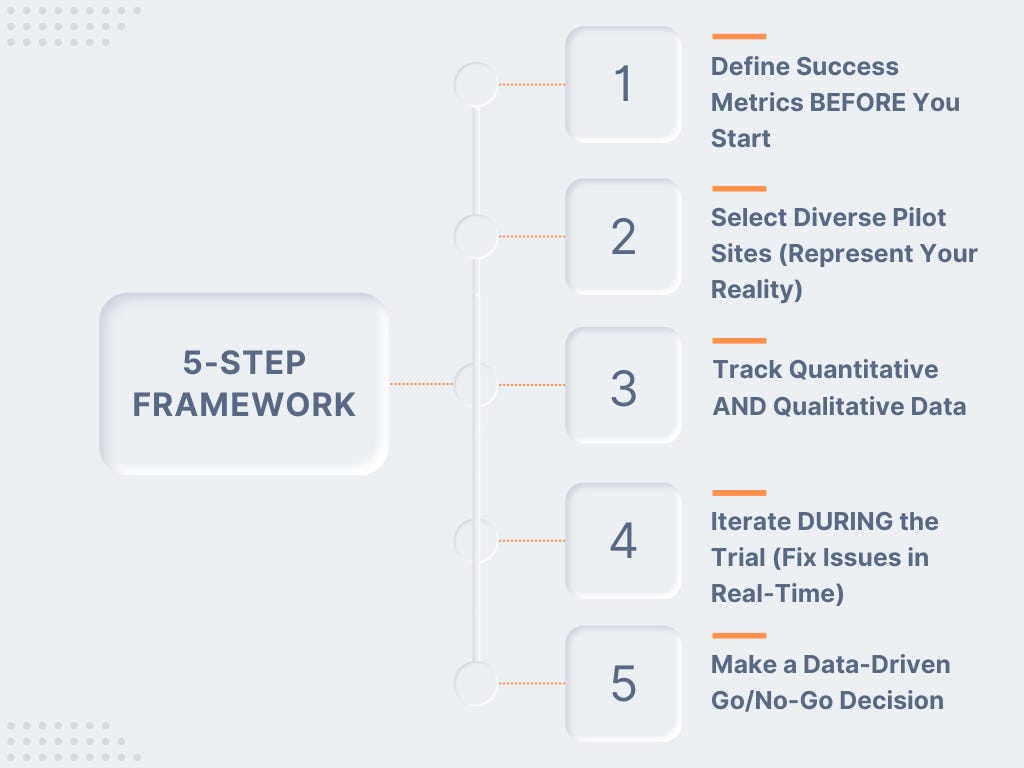
Step 1: Define Success Metrics BEFORE You Start
Don’t wait until the end to figure out what success looks like. Before deploying anything, answer:
What quantitative metrics prove this works? (volume, completion rates, time savings, cost reduction)
What qualitative feedback would indicate success? (user satisfaction, reduced frustration, easier workflows)
What would cause you to cancel or significantly delay rollout? (low adoption, high abandonment, negative safety impact)
Write these metrics down. Share them with stakeholders. Use them to make your go/no-go decision. Once you move past this point, do not change them.
Step 2: Select Diverse Pilot Sites (Represent Your Reality)
Don’t stack the deck with friendly sites. Pick sites that represent the full spectrum of your portfolio:
Technology adoption levels (champions AND skeptics)
User demographics (age, experience, language, technology comfort)
Project types and phases (different workflows and constraints)
Volume scenarios (low-use and high-use cases)
Geographic and connectivity diversity (urban vs. remote, strong vs. weak connectivity)
If your pilot only includes ideal conditions, you’ll discover the problems during rollout instead of during the trial. Save yourself the trouble and fix it first, it’s much more expensive later.
Step 3: Track Quantitative AND Qualitative Data
Numbers tell you what is happening. Conversations tell you why.
Quantitative: Usage metrics, completion rates, time tracking, volume, error rates Qualitative: Formal user interviews, observation sessions, anonymous surveys, pain point documentation
Schedule interviews with ALL user types:
Your own team members
Subcontractors and trade partners
Both champions and skeptics
High-volume users and occasional users
Ask open-ended questions. “Walk me through the last time you used this” yields better insight than “Do you like this system?”
Step 4: Iterate DURING the Trial (Fix Issues in Real-Time)
The trial isn’t just validation. It’s development. When users identify problems:
Implement fixes within days or weeks, not months
Communicate changes back to users (”We heard your feedback about X, here’s what we changed”)
Show that feedback matters through action, not just listening
This builds trust and turns users into collaborators. They’ll forgive imperfections if they see you’re actively improving based on their input.
Step 5: Make a Data-Driven Go/No-Go Decision
At the end of your trial period, compare results to your predefined success metrics:
Did you hit your quantitative targets?
Was qualitative feedback positive overall?
Were major pain points addressed?
Do you have confidence this will work at scale?
If yes to all four: Proceed with rollout If no to any: Extend trial, make additional changes, or reconsider the technology
We had one stakeholder requirement (single approver) that created a bottleneck we couldn’t fully solve in the trial. We proceeded anyway because:
The overall metrics strongly supported rollout
We had a future solution identified (automation expansion)
Users accepted the tradeoff given other improvements
The bottleneck was manageable at current volumes
Perfect is the enemy of good. But “good enough to roll out” requires real evidence, not hope.
What This Approach Achieves
The five-month trial added time to our deployment schedule. We could have skipped it and rolled out to all sites immediately.
But here’s what the trial bought us:
Confidence: We’re not guessing if this will work. We have data proving it does.
Credibility: When skeptical site leaders push back, we have 30 user testimonials and 700+ successful permits to point to.
Champions: Multiple sites worth of early adopters who will help train and support the next wave.
Refined system: 20 improvements we wouldn’t have known to make without real-world use.
Momentum: Excitement from teams asking to join, not resistance we have to overcome.
When we deploy to 20+ sites in early 2026, we’ll do it with confidence. Because we’ve already validated the system works in real-world conditions with real users under real constraints.
The Bottom Line
Most construction technology fails not because the technology is bad, but because the implementation ignores reality. Companies buy solutions designed for ideal conditions, deploy them into messy real-world environments, and wonder why adoption fails.
The pilot program approach flips this. You find the messy reality during the trial, fix the problems while the stakes are low, and build confidence before scaling.
It’s not faster. But it’s dramatically less risky.
And in an industry where failed technology rollouts cost six figures and destroy your credibility with field teams, taking a few extra months to get it right is the smartest investment you can make.